Migraine After Work: How Stress, Screens, Skipped Meals and Dehydration Trigger Pain
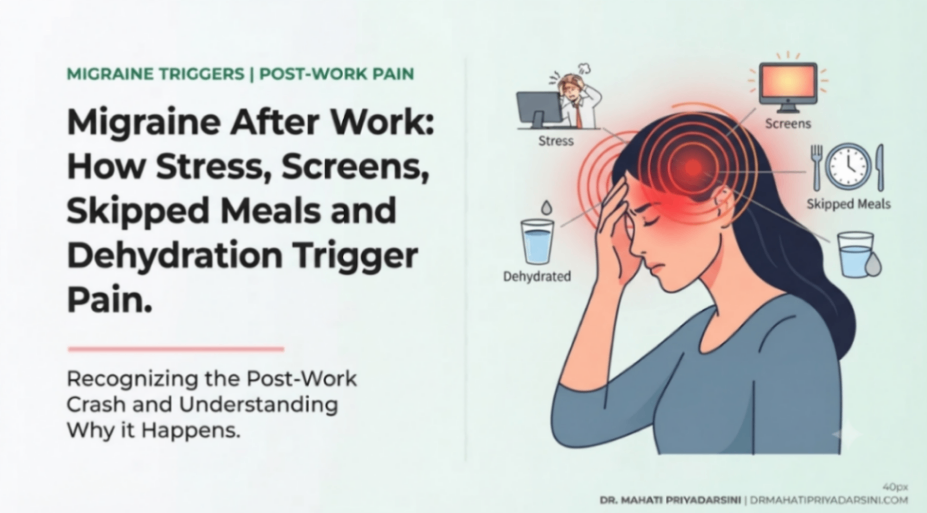
Have you ever finished a long day at work, closed your laptop, and suddenly realised your head is pounding?
Maybe you felt completely fine when you arrived at the office. Then came the meetings, deadlines, emails, screen time, a rushed lunch and probably far less water than you intended to drink. By the time you're heading home, the headache has become impossible to ignore.
If this happens regularly, you're not alone.
A long workday can bring together several things that may trigger a migraine stress, tiredness, bright screens, missed meals and dehydration. Sometimes it's not one particular thing that causes the attack. It's the combination that builds up over several hours.
Here's why that can happen.
What exactly is a migraine?
A migraine is more than just a bad headache.
It's a neurological condition that can cause moderate to severe pain, often with a throbbing or pulsing feeling. Some people also experience nausea, vomiting, sensitivity to light or sound, or visual changes during an attack.
The tricky part is that migraine triggers aren't the same for everyone.
Something that causes an attack for one person may not affect someone else at all. That's why noticing what happens during your workday can be surprisingly useful.
Why can a long workday trigger migraine?
1. Stress keeps building up
Work stress is one of the most common things people associate with migraine.
A difficult meeting, a tight deadline or a day packed with constant interruptions may not cause pain immediately. But after hours of staying alert and under pressure, your body may finally start showing the strain.
Interestingly, some people notice their migraine after the stressful situation is over rather than during it.
You finish the deadline, leave the office, and that's when the pain begins.
That doesn't necessarily mean relaxing caused the migraine. The triggers may have been building throughout the day.
2. You're spending hours in front of a screen
For many office workers, the workday means staring at a laptop for eight hours or more.
Then there's the phone.
Long periods of screen use can mean prolonged concentration, fewer breaks and exposure to bright light. For someone who is already prone to migraine, these factors may contribute to an attack.
If you notice your headache regularly starting after several hours at your desk, pay attention to how much uninterrupted screen time you're getting.
Even short breaks can make a difference to how your workday feels.
3. Lunch keeps getting delayed
You planned to eat at 1 PM.
Then a meeting ran over.
Then someone needed something urgently.
Suddenly it's 3 PM and you've had nothing since breakfast.
Going for long periods without eating can be a migraine trigger for some people. It can also leave you feeling tired, irritable and less able to concentrate which isn't exactly helpful when you're already having a demanding day.
Try not to make skipped meals a regular part of your work routine.
A predictable eating schedule is often easier on your body than waiting until you're completely hungry.
4. You simply haven't had enough water
This one is easy to miss.
When you're busy, it's surprisingly common to reach the end of the afternoon and realise you've barely touched your water bottle.
Dehydration can cause headaches and may contribute to migraine attacks in people who are susceptible to them.
Coffee may be part of your workday, but don't let it replace your water intake.
Keeping a bottle next to your laptop is a simple reminder to drink regularly instead of trying to catch up at the end of the day.
5. Your neck and shoulders have been tense for hours
A long day at a desk doesn't just affect your eyes.
Sitting in the same position for hours, leaning towards a laptop or unconsciously tightening your shoulders while concentrating can leave your neck and upper back feeling stiff.
For some people, this physical tension can add to their headache or migraine symptoms.
Try changing your position regularly. Stand up, walk around for a few minutes and gently move your neck and shoulders rather than staying fixed in the same position all afternoon.
What about bright lights and noise?
Your workplace may have its own collection of potential triggers.
Bright overhead lights. Screen glare. Constant background conversations. Strong perfumes. Loud meetings.
None of these will trigger migraine in everyone. But if you notice a consistent pattern for example, headaches that start after working under particularly bright lighting it's worth paying attention to it.
A migraine diary can help.
Write down when the headache started, what you ate, how much water you had, how long you worked at a screen, how you slept the previous night and what was happening around you.
After a few weeks, patterns can become much easier to spot.
Why does the migraine sometimes appear when you leave work?
This can be confusing.
You've survived the entire day. You finish your work, step outside the office and suddenly your head starts hurting.
It can feel as though leaving work caused it.
But often, the opposite may be happening.
The stress, lack of food, dehydration, screen exposure and tiredness have been accumulating throughout the day. Once the pressure finally drops, the migraine becomes noticeable.
This is one reason a headache that appears in the evening shouldn't automatically be blamed on one thing that happened just before you left work.
Look at the whole day.
What can you do to reduce migraine triggers at work?
You don't need to make your working day perfect.
A few simple habits can help:
● Don't regularly skip meals or leave very long gaps between them
● Keep water within easy reach throughout the day
● Take short breaks from your screen instead of working continuously for hours
● Adjust screen brightness if it feels uncomfortable
● Get up and move around regularly
● Try to keep your sleep schedule reasonably consistent
● Notice whether particular lights, smells, foods or stressful situations repeatedly precede your migraine
● Keep a simple record of your migraine attacks and possible triggers
The goal isn't to avoid every possible trigger.
That's almost impossible.
It's about understanding your own pattern and reducing the combination of factors that seems to push you towards an attack.
When should you see a doctor?
An occasional headache after a tiring day isn't necessarily a reason to worry.
But recurring or changing headaches deserve proper attention.
It's worth speaking with a doctor if:
● Your headaches are becoming more frequent or severe
● You regularly miss work or normal activities because of migraine
● Your usual migraine pattern has changed
● You frequently need pain medication to manage your headaches
● Your headaches are interfering with your sleep
● You develop new or unusual symptoms along with the headache
A proper evaluation can help confirm whether your symptoms are migraine and identify a treatment approach suited to you.
A realistic word about managing migraine
If your migraine keeps appearing after work, don't assume that you simply need to "handle stress better."
Sometimes several small things are happening at once.
You may have started the day tired, skipped lunch, spent hours looking at a screen, forgotten to drink water and then spent the afternoon dealing with a deadline.
Any one of these might not be enough to trigger an attack. Together, they can be a different story.
Pay attention to the pattern rather than blaming yourself for the pain.
Understanding what happens before your migraine is one of the first steps towards managing it more effectively.