Tennis Elbow Without Playing Tennis: How Your 9-to-5 Could Be Triggering Elbow Pain
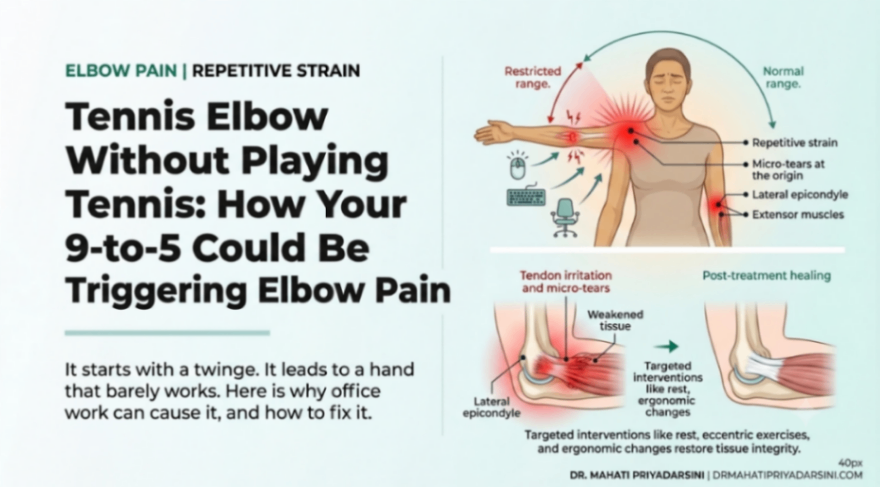
Do you spend most of your day typing using a mouse answering phone calls or working on a laptop?. Lately have you felt a persistent ache on the outer part of your elbow when you lift a cup open a door or shake a hand?
You might think tennis elbow only occurs to people who play tennis. Tennis elbow does not belong to tennis players.
In fact repetitive motions at your desk can put high stress on the muscles and tendons, near your elbow. Over time that repeated strain can create tennis elbow.
The good news is that most cases of tennis elbow can be treated without surgery. The key is recognising tennis elbow early of continuing to work while feeling pain.
Here's what's going on
What exactly is tennis elbow?
Tennis elbow, also known as epicondylitis occurs when the tendons that connect the forearm muscles to the outer part of the elbow become irritated or overworked.
These tendons allow you to lift the wrist and move the fingers. When you repeat the motion over and over- typing using a mouse holding a phone or lifting objectsthe tendons can become painful and small areas of damage may develop.
You do not have to play tennis to get Tennis elbow. A long 9-to-5 job, at a computer can be enough especially if your desk setup is not ideal or if you spend hours performing the same hand and wrist movements without taking breaks.
How can your office job cause tennis elbow?
I have noticed that my elbow may not feel busy while I sit at a desk. My forearm muscles are working all the time.
Some common workplace triggers include:
1. Long hours on the computer.
I see that typing and using the mouse keep the forearm muscles busy for many hours.
If I do not take breaks the tendons may become overloaded.
2. Poor wrist position.
I notice that if my keyboard or mouse is too high, too low or far away I can keep my wrist bent while working.
This puts tension on the forearm tendons.
3. Repeated gripping.
I see that holding a phone gripping a mouse tightly or carrying files and office equipment regularly can strain the muscles attached to the elbow.
4. Working without breaks.
I notice that eight or nine hours of movement without letting my muscles recover can turn a small irritation into lasting pain.
5. Sudden increase in activity.
I find that sometimes the problem begins when I suddenly take on computer work, a new project, more meetings that need note‑taking or heavier tasks, at home.
How to recognise tennis elbow
The symptoms can come on slowly which is why a lot of people don't pay attention to them in the beginning.
The usual signs are:
● Pain or tenderness on the outside of the elbow
● Pain that moves down toward the forearm
● Trouble when holding or squeezing something
● Pain when lifting a cup, a bag or a laptop
● Weakness in your hand or wrist
● Pain when turning a doorknob or opening a jar
● Stiffness or soreness after a day, at work
Here's a clue: the pain usually gets worse when you use your wrist or grip something instead of when you just move your elbow.
Why shouldn't you ignore elbow pain?
It's easy to think, "It's just work. I'll rest over the weekend."
Sometimes that is enough in the early stages. But if the same activity continues day after day, the irritated tendon doesn't get much opportunity to recover.
That can turn occasional discomfort into pain that follows you through the entire working day.
You may eventually find simple things typing, holding a coffee mug, driving, or carrying a bag surprisingly uncomfortable.
And once the pain starts affecting your work, it becomes much harder to ignore.
What can you do at home?
For mild, early tennis elbow, a few simple changes can help:
● Give your elbow regular breaks. Get up from your desk, move your arm gently, and avoid doing the same hand movement continuously for hours.
● Check your workstation. Keep your keyboard and mouse at a comfortable height and try to keep your wrist in a neutral position rather than constantly bent.
● Reduce gripping. Don't hold your mouse or phone more tightly than necessary.
● Use ice for pain. A cold pack for around 15 minutes after activity may help reduce pain and irritation.
● Try gentle exercises. Stretching and strengthening the forearm muscles can gradually improve tendon strength. A physiotherapist can show you the right exercises and how much is appropriate.
● Don't completely stop using your arm. Too much rest can make the area stiff and weak. The goal is to reduce irritating activities while keeping the arm gently moving.
What treatment actually works?
The right treatment depends on how bad your symptomsre what is causing them.
For people physical therapy is an important part of getting better. A planned program can include stretching, exercises to build strength fixing how you move and tips on changing the activities that are hurting the tendon.
Medicine that helps with pain or reduces swelling may also be suggested for a time depending on your personal situation.
If the pain stays after trying other treatments a doctor can check if you need more options, like special injections or other methods.
The important thing is to fix the reason, for the problem not just keep using painkillers while doing the same activity that is hurting the tendon.
.
When should you see a specialist?
It's worth getting your elbow checked if:
● Pain has continued for more than a few weeks
● The pain is getting worse instead of better
● You are finding it difficult to grip or lift everyday objects
● Your hand or wrist feels noticeably weak
● Pain is interfering with your work or sleep
● You developed the pain after an injury
● Rest and simple home measures haven't helped
Elbow pain isn't always tennis elbow. Nerve irritation, arthritis, other tendon problems, or an injury can cause similar symptoms. Getting the right diagnosis is therefore important.
A realistic word about recovery
Tennis elbow can be frustrating because the pain often improves slowly. Tendons do not always recover overnight especially when you are still using your arm for hours every day.
The good news is that most people, with Tennis elbow improve with the combination of activity changes, physiotherapy and appropriate treatment.
The biggest mistake is continuing to push through the pain and hoping it will disappear on its own.
If your 9-to-5 involves hours of typing, clicking, gripping or repetitive hand movements your elbow may be telling you that something needs to change because of Tennis elbow.
The bottom line
You don't have to play tennis to get tennis elbow.
Your desk, mouse, keyboard, phone and regular daily actions can all cause elbow pain when your muscles and tendons don't have time to rest.
Don't wait until something, like a cup of coffee or a handshake becomes painful. If your elbow pain keeps coming get it checked properly.
With the diagnosis and treatment you can take care of your elbow return to easy movement and make sure your workday doesn't turn into a lasting source of pain.