Back Pain From Sitting All Day: What Working Professionals Should Know
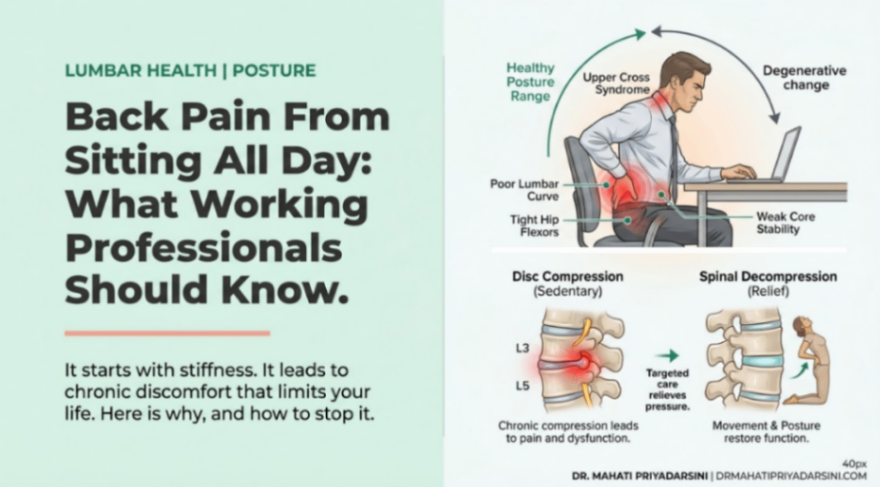
You sit down at your desk when the morning comes start looking at emails go to a meetings and then check the clock. It's strange. Three or four hours have passed. Then you get up.
That's when you feel it a low pain in your back tightness around your waist or that uncomfortable feeling that makes you want to stretch before you can move properly.
For people who spend most of the working day at a desk this can become something that feels normal. Back pain, from sitting all day isn't something you should automatically accept as part of office life.
Here's whats going on.
Why does sitting for hours affect your back?
Your back is made to move not to stay in the same position all day.
When you are sitting, especially if you are leaning towards your laptop or slowly sliding into a position the muscles around your spine have to keep holding you up.The muscles around your spine get tired after a while.
Most people do not sit in the way all day. You lean forward to read something on your laptop you twist to talk to a colleague you stretch to get your phone then you sit back in your chair.
Your back can start hurting if you do this every day, for months and years your back can really start complaining.
A few things commonly make it worse:
· Long periods without movement. Even a reasonably comfortable chair becomes a problem when you're sitting in it for hours without getting up.
· Slouching. Letting your shoulders and lower back collapse forward can put additional strain on the structures supporting your spine.
· A poorly arranged workstation. If your screen is too low and you are always reaching for your keyboard or mouse your posture can get worse without you realizing it. This can happen slowly over time. It is important to make sure your screen is at the height. It should be at or just, above eye level. Your keyboard and mouse should be close enough so you don't have to stretch. Good posture helps prevent aches and pains. It also makes sitting for periods more comfortable. Pay attention to how you sit. Make changes if needed. Your body will thank you for it.
· Weak or stiff muscles. Spending most of the day sitting means your hips and other supporting muscles aren't getting much movement.
The problem isn't necessarily sitting itself.
It's sitting for too long without changing position or moving enough
What does sitting-related back pain feel like?
There isn't one particular type of pain that everyone gets.Some people describe a dull ache across the lower back. Others notice stiffness when they get up from their chair after a long meeting.
You may also notice:
· Back stiffness towards the end of the workday
· Pain after sitting through long meetings
· Tightness around the lower back or hips
· Discomfort that improves after walking around
· Pain that returns when you sit down again
That last one can be a clue. If your back feels better after you have walked around for a minutes but starts aching again after another long time sitting at your desk then sitting for a long time may be part of the problem, with your back.
It does not explain every kind of back pain that people get with their back.
When is back pain more than just sitting too long?
You should not just blame your office chair for this.Back pain is a problem that needs to be looked at especially when it keeps coming or gets worse over time.This is more important when you have other symptoms with the back pain.
See a doctor if you have pain and these things happen to you:
· Pain that continues for several weeks
· Pain that is getting worse rather than settling
· Pain travelling from your back into your buttock or leg
· Numbness or tingling
· Weakness in your leg
· Pain that regularly disturbs your sleep
· Difficulty walking or doing normal daily activities
These symptoms do not always mean that there is a serious problem, but they are a sign that it is better not to ignore the pain or try to diagnose it on your own. A professional evaluation can help identify whether the discomfort is coming from muscle strain, posture, or another underlying issue. And no, you don’t have to give up your office chair or spend the entire workday standing to feel better.
Small changes are usually more realistic and easier to maintain.Get up during the day. Walk around for a few minutes between tasks rather than staying seated in your chair until it is time, for lunch.
Change your position. Don't spend the entire day trying to hold one “perfect” posture. Move around. Don't stay in one position for too long. Look at your screen. Your monitor should be placed so you are not constantly bending your neck or leaning forward to see it. Keep your feet supported. A stable sitting position can make it easier to avoid postures .
Move outside work too. Taking a walk after work is really good for you. It is better, than sitting at your desk all day and then going to the sofa when you get home every evening. Walking around a bit helps your back and hips. It stops them from getting really stiff.
If your back or hips already hurt do not start doing really hard exercises you saw on the internet. The exercises you should do depend on why your back or hips hurt.
What treatment can help?
If changing the way you do things every day isn't enough the next thing to do is find out why the pain is happening.
The treatment for pain is different depending on what's causing the pain. The doctor may tell you to do guided physiotherapy. You may have to do exercises to build up your strength and improve the way you move. You might have to make some changes, to how you sit or move around during the day. The doctor may also give you medicine to help ease the pain when you need it.Some people might need focused treatment if their pain comes from a specific problem.
The key point is to not use the treatment for all types of back pain.
A treatment that works for one person might not be the choice, for another.
When should a working professional get checked?
If you're regularly finishing your workday by reaching for a painkiller, that's probably a sign to pay attention.
You should consider seeing a specialist if:
· Your back pain keeps coming back
· Sitting is becoming increasingly uncomfortable
· Pain is affecting your sleep
· You're avoiding activities you normally enjoy
· The pain is spreading into your leg
· You have numbness or tingling or weakness
Getting help does not automatically mean you will need an injection or procedure or surgery . Often the first step is simply finding out what is actually causing the pain and what can be done about it
A realistic word about sitting and back painIf you work at a desk, you're probably going to spend a lot of time sitting. That's unlikely to change.But you don't have to spend eight or nine hours in exactly the same position.
Stand up between meetings. Walk while taking a phone call. Stretch when you feel stiff. You need to set up your workstation . The most important thing is do not keep ignoring the pain that is becoming a regular part of your day.
Your back is sometimes simply asking you to move
Your back is sometimes telling you that your workstation or the way you are working needs a look, at the workstation.
The bottom line
Back pain from sitting all day is a problem that a lot of working professionals have.. You should not think that back pain is just something that comes with having a desk job.
You can do things to make the back pain better. If you move around regularly and have a workstation that is set up well this can really help. You should also try to have habits every day. Back pain, from sitting all day can be helped by doing these things.
But when pain keeps returning, becomes worse, affects your sleep, or starts travelling into your leg, it's worth getting properly assessedYour work may keep you at a desk.
That doesn't mean your back has to pay the price.