Elbow Pain Treatment Without Surgery: What Works for Office Workers
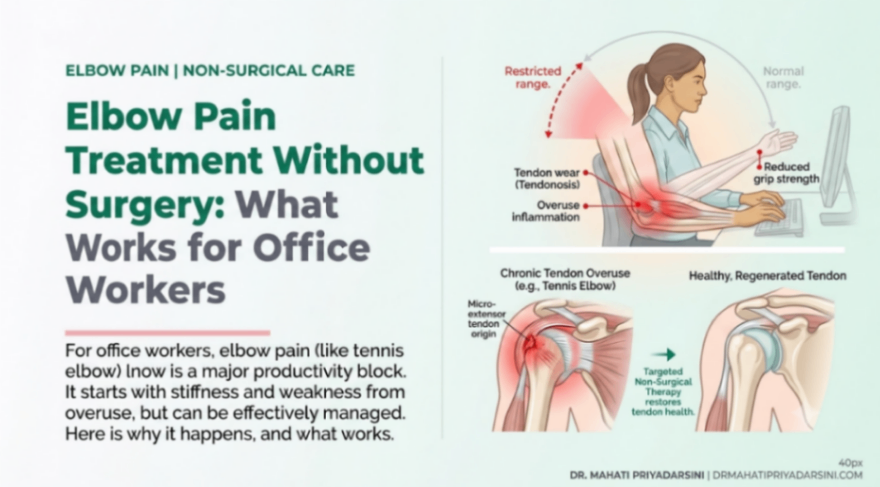
You don't play tennis. You don't lift weights. So why does your elbow hurt?
If you spend most of your day at a desk the answer might be there in your everyday habits.
Typing on a keyboard clicking a mouse holding your phone for periods carrying a laptop bag these actions seem harmless at first. But doing them over and over hour after hour can put a lot of strain on the muscles and tendons around your elbow.
At the beginning it might just feel like a twinge. Maybe an occasional ache when you reach for your coffee cup or open a bottle.. When you carry something that’s just a little heavy.
That’s usually when people start asking: "Do I need surgery?"
Not always.
Most cases of elbow pain don’t require surgery. The key is knowing what’s really causing the discomfort. It's not about ignoring the pain. It's, about figuring out the root issue and treating it properly.
Why does sitting at a desk cause elbow pain?
Your elbow is connected to everything that is happening in your forearm and wrist.
When you are typing or moving a mouse the muscles, around your forearm are working all the time. Add hours of gripping, clicking and keeping your hand in the position and those tissues do not get much of a chance to rest.
This can slowly lead to irritation around the elbow.
It does not always happen all at once.
You may not remember one moment when you hurt yourself. Instead the pain slowly becomes part of your workday.
Can elbow pain really get better without surgery?
In many cases, yes.
There isn't one treatment that works for every person with elbow pain.
Someone with tendon irritation may need an approach from someone whose pain is coming from a joint or an irritated nerve.
That's why simply searching for "the best elbow pain treatment" and trying remedies, on your own may not get you very far.
A proper assessment comes first.
Once the cause is understood treatment can usually be planned around your symptoms, your work and how much the elbow is affecting your activities.
What does non-surgical treatment involve?
1. Find out what's causing the pain
This sounds obvious, but it's often missed.
Where exactly does the elbow hurt? Does it hurt when you grip something? Is there weakness? Does the pain travel into your forearm or hand?
These details matter.
A specialist can examine the elbow and your arm to understand whether the problem is related to a tendon, muscle, joint or nerve.
Without knowing the cause, you're essentially treating the pain blindly.
2. Give the irritated area time to recover
If a particular activity keeps making the pain worse, continuing it at the same intensity may keep the problem going.
For an office worker, this could be something as ordinary as hours of mouse use or repeatedly gripping objects.
You don't necessarily have to stop working. The idea is to reduce the activity that is aggravating the elbow while it settles.
3. Physiotherapy can help restore strength
Once the cause of the pain is clear, physiotherapy may become part of the treatment.
The goal isn't simply to make the elbow feel better for a few days. It is to help the muscles and tendons around the elbow become stronger and handle normal activities again.
A physiotherapist can also adjust the treatment as your symptoms improve instead of asking you to do the same exercises indefinitely.
4. Pain relief may be part of the plan
Depending on your condition, your doctor may recommend medication or other measures to control the pain.
This can make everyday activities easier while the underlying problem is being treated.
But pain relief alone isn't always enough.
If the reason behind the elbow pain isn't addressed, the same discomfort can return once you get back to your usual routine.
5. Gradual recovery is usually better than pushing through
One common mistake is doing too much as soon as the pain starts feeling better.
You have a good day, assume the elbow is fine and go straight back to everything you were doing before.
Then the pain returns.
Recovery often works better when activity is increased gradually. Your treatment should help you get back to normal use of your arm without repeatedly overloading the painful area.
What about tennis elbow if you work in an office?
The name can be confusing.
You can have tennis elbow without ever playing tennis.
Tennis elbow refers to pain involving the tendons on the outside of the elbow. Repeated gripping and wrist movements can contribute to it, which is why people who work at computers can experience it too.
For some office workers, the first sign isn't even severe pain. It may simply be discomfort when using the mouse, shaking hands or lifting a cup.
If those symptoms keep returning, it's worth having them checked.
When should you stop ignoring elbow pain?
An occasional ache after a particularly long day may settle down.
But it's a different story when the pain keeps coming back or starts affecting normal activities.
Consider seeing a specialist if:
The pain has lasted for several weeks
Picking up or gripping things has become difficult
You notice weakness in your hand or arm
The elbow is swollen or very tender
You have numbness or tingling
You cannot move the elbow normally
The pain continues despite trying to manage it at home
These symptoms don't automatically mean something serious is wrong. They simply mean it's time to stop guessing and get the elbow properly assessed.
Does persistent elbow pain mean you'll need surgery?
Not necessarily.
If your pain isn't improving, your doctor may first look at whether the diagnosis is correct and whether the current treatment needs to be changed.
Depending on the cause, non-surgical treatment may include physiotherapy, activity modification, medication and other appropriate treatments.
Surgery is generally considered only in selected situations, such as when appropriate conservative treatment hasn't helped enough or when there is a specific problem that requires surgical correction.
So don't assume that an aching elbow today means an operation tomorrow.
The bottom line
Elbow pain is often ignored when you spend most of your day sitting behind a computer.
You might think elbow pain is a sign of getting older of long hours at work or of using a mouse too much. Persistent elbow pain deserves attention. The right way to treat elbow pain begins with discovering why the elbow hurts. Often a mix of treatment and rehabilitation can bring you back, to work and daily life without surgery.
If elbow pain has been bothering you for weeks do not wait for it to vanish on its own. Getting elbow pain assessed early can help you know what is happening and what your choices are.