Elbow Pain After 35: Common Causes You Shouldn’t Ignore
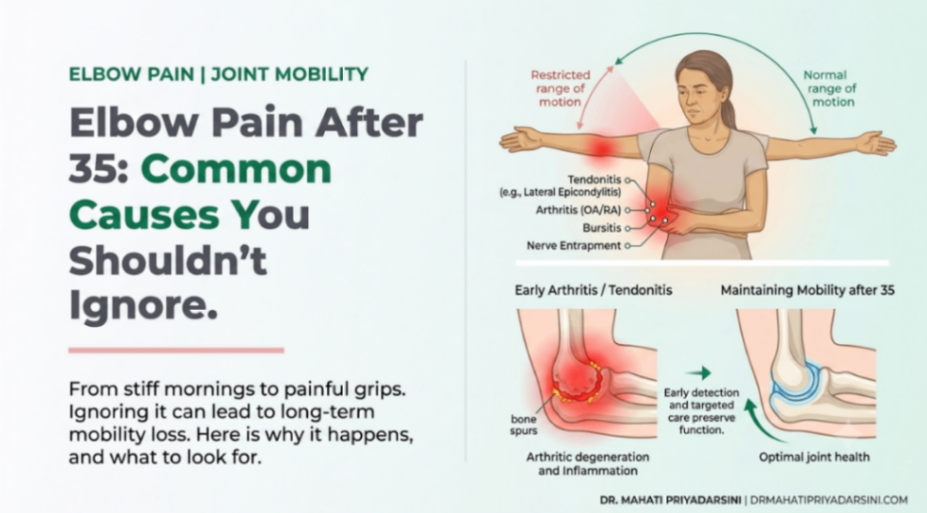
Your elbow probably aren't something you think about much.
You use elbow all day without noticing. Lifting a bag typing at your desk, cooking, carrying groceries working out or reaching for something on a shelf.
So when elbow starts hurting even simple things can suddenly become irritating.
Maybe elbow starts as an ache after a long day. You may notice elbow pain when you pick up a cup or lift something, than usual. Sometimes elbow settles down. Sometimes elbow keeps coming.
And that is when many people think, “It’s probably just age.”
But elbow pain after 35 should not automatically be blamed on getting older.
There are several possible reasons for it. The problem may involve a tendon, the joint, a nerve or even an old injury. Knowing the cause matters because the right treatment depends on what is actually going on.
Why can elbow pain become more noticeable after 35?
The elbow is a joint that is used a lot.
Three bones meet there. Muscles, tendons, ligaments and nerves. Whenever you bend your arm grip something or lift an object these parts work together.
Over the years all that repeated use can start to show.
For someone, with a desk job the strain may not be obvious. Spending hours typing, using a mouse or keeping your arm in one position can put repeated stress on the muscles and tendons that surround the elbow.
It does not always hurt away. Sometimes the pain builds slowly. Only becomes noticeable after weeks or months.
Common causes of elbow pain
1. Tennis elbow
The name makes it sound like a problem only tennis players get.
That is not the case.
Tennis elbow usually affects the tendons on the outside of the elbow and is often linked to repeated use of the wrist and forearm.
You may feel pain while gripping, lifting a bag, opening a jar, shaking hands or picking up a cup.
It can begin with a mild ache and gradually become more noticeable during everyday activities.
2. Golfer's elbow
Golfer's elbow is another tendon problem, but the pain is usually felt on the inside of the elbow.
And just like tennis elbow, you do not need to play golf to develop it.
Repeated gripping, lifting and certain wrist movements can irritate the tendons in this area.
For some people, the pain is most noticeable while doing routine tasks at home or at work.
3. Arthritis
Arthritis can affect more than just the knees and fingers.
It can also involve the elbow.
When this happens, you may notice pain, stiffness, swelling or reduced movement in the joint. Some people find that the elbow feels particularly stiff after sitting still for some time.
If your elbow has gradually become harder to bend or straighten, it is worth getting it checked rather than assuming it is simply part of getting older.
4. Repetitive strain
Not every elbow problem starts with one obvious injury.
Sometimes there is no particular moment when you can say, “That’s when I hurt it.”
Instead, the discomfort slowly builds from repeated movements.
Lifting, cleaning, gardening, exercise, household work and certain job-related activities can all place extra stress on the muscles and tendons around the elbow.
Because these are often normal parts of daily life, it can be easy to overlook the strain until the pain becomes more frequent.
5. Nerve irritation
Elbow pain is not always coming from the joint itself.
A nerve passes through a narrow area around the elbow, and irritation or pressure on that nerve can cause symptoms that feel different from ordinary soreness.
You may notice tingling or numbness in your fingers. There can also be a burning or electric-like feeling, or weakness in the hand.
These symptoms are worth paying attention to because nerve-related problems may need a different type of treatment.
6. An old injury
An elbow injury from years ago may still be relevant today.
Perhaps you fractured the elbow, had a bad fall or suffered a sports injury. Even if it seemed to heal properly at the time, an old injury can sometimes affect movement or put extra stress on the surrounding tissues.
So when seeing a doctor for ongoing elbow pain, mention any previous injury, even if it happened a long time ago.
Where the pain is can give your doctor a clue
One useful thing to notice is where you actually feel the pain.
Pain on the outside of the elbow can be linked to problems such as tennis elbow.
Pain on the inside may involve the tendons in that area.
Pain, at the back of the elbow can come from reasons especially if there is swelling or if it hurts when you touch it.
If the pain moves toward the hand along with a feeling of numbness or pins and needles a nerve could be the cause.
This does not mean you can figure out the problem by where it hurts.
Paying attention to where it hurts what kind of pain it is and what movements make it worse can help a specialist know what to look at more closely.
Not every elbow ache needs immediate medical attention.
But it is worth speaking to a specialist when:
· the pain has lasted for more than a couple of weeks
· the elbow is swollen, red or warm
· you cannot fully bend or straighten the arm
· your grip feels weaker than usual
· you have numbness or tingling in the hand or fingers
· the pain keeps returning
· it is interfering with work, exercise or daily activities
· the pain started after a fall or other injury
These symptoms do not automatically mean that the problem is serious.
They simply mean it is better to understand the cause instead of continuing to put it off.
How is the cause of elbow pain diagnosed?
There is no single test that explains every type of elbow pain.
A specialist will usually start with your history.
When did the pain begin? Did it come on gradually or suddenly? What activities make it worse? Have you injured the elbow before?
The elbow will then be examined, including its movement and strength. Your doctor may also look at the surrounding muscles, tendons and nerves.
Depending on the symptoms, an X-ray, ultrasound or MRI may be recommended.
The aim is to find out where the problem is coming from.
A tendon problem, arthritis and nerve irritation can all cause elbow pain, but they do not require the same approach.
When should you see an elbow pain specialist?
If your elbow hurts once after unusual activity and quickly settles, you may not need to worry.
But ongoing or recurring pain is different.
When the discomfort starts affecting simple things such as lifting, gripping, typing, exercising or sleeping, it is a good idea to get it assessed.
For people looking for an elbow pain doctor in Hyderabad, a proper evaluation can help identify whether the problem is related to a tendon, joint, nerve or previous injury.
Depending on the cause, treatment may include physiotherapy, specific exercises, changes to daily activities, medicines or other treatments recommended by your specialist.
The goal is not simply to reduce the pain temporarily.
It is to understand why it is happening and choose treatment that addresses the actual problem.
The Bottom Line
Elbow pain after age 35 is not something you have to accept as part of getting older.
It can happen because of repeated strain, problems with tendons, arthritis, nerve issues or a past injury.
The key is to pay attention when the pain does not go away or keeps coming.
Your elbow might be trying to tell you that it needs attention.
So if the pain starts to affect your job, your workouts or your daily tasks do not just try to live with it.
Finding out what is causing the pain early can help you pick the treatment and get back, to the things you usually do.