Frozen Shoulder: Why It Happens and How to Get Your Movement Back
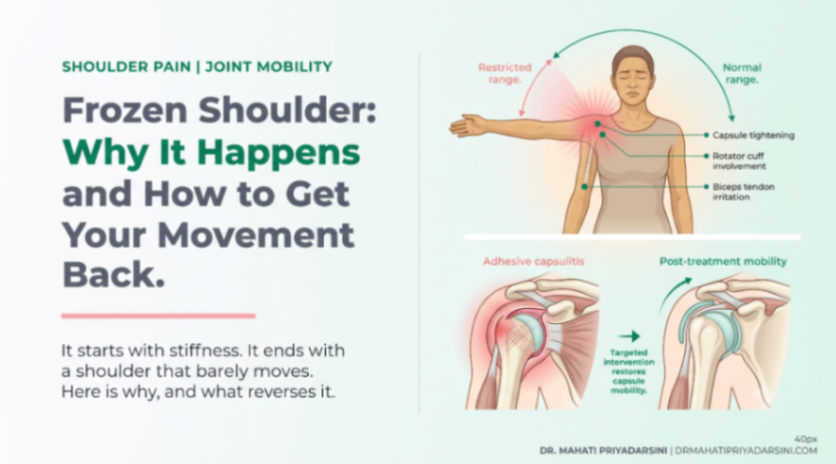
Frozen Shoulder: Why It Happens and How to Get Your Movement Back
Have you been waking up at night because your shoulder aches? Or noticed that reaching up to a high shelf, or behind your back, has slowly become harder over the past few months? If so, you might be dealing with something called frozen shoulder.
It's a sneaky problem. It builds up slowly, it's often mistaken for other shoulder issues, and if you ignore it, it can quietly make everyday life surprisingly difficult.
Here's what's going on.
What exactly is frozen shoulder?
Your shoulder joint is wrapped in a thin layer of tissue, a bit like a stretchy sleeve, that lets the joint move smoothly. In frozen shoulder, this sleeve becomes inflamed, thickened and tight. Over time, it can develop scar-like tissue that shrinks the space inside the joint, so moving your arm becomes painful and stiff.
The medical name for it is adhesive capsulitis, but the everyday name says it best: the shoulder slowly "freezes" up.
A few things it is not:
● It's not a torn muscle.
● It's not arthritis.
● It's a problem with that "sleeve" around the joint — nothing else.
It's also more common than people think; roughly 2 to 5 out of every 100 people get it at some point. It shows up more often in women, in people over 40, and in those with diabetes or thyroid problems.
It happens in three stages
Frozen shoulder doesn't appear overnight. It moves through three stages, and knowing which one you're in helps you understand what to expect.
Stage 1 — the "freezing" stage (the painful one). This lasts roughly 2 to 9 months. The pain builds slowly, is often worse at night, and your arm starts to lose movement. A lot of people assume it's just a small strain and wait for it to pass — which sadly gives the problem time to get worse.
Stage 2 — the "frozen" stage (the stiff one). The pain often eases off, but stiffness takes over. Simple things — reaching overhead, fastening a bra strap, putting on a jacket — become genuinely hard. This stage can last 4 to 12 months.
Stage 3 — the "thawing" stage (recovery). Movement gradually comes back. This can take anywhere from 6 months to 2 years. The good news: with the right treatment, recovery is quicker and more complete.
How to recognise it
The usual signs are:
● A deep, dull ache in the shoulder, sometimes spreading into the upper arm
● Pain that gets worse at night and disturbs your sleep
● A slow loss of movement in every direction — not just one
● Trouble with anything that needs twisting or reaching — combing your hair, reaching behind your back, lifting things overhead
● No obvious injury to explain it (unlike a pulled muscle, frozen shoulder usually starts on its own)
Here's the telltale sign that sets it apart: with frozen shoulder, your arm won't move far, even when someone else tries to move it for you. With a simple muscle problem, another person can usually move your arm further than you can on your own. That difference is a big clue for doctors.
Why does it happen?
Often, there's no clear reason. But some things make it more likely:
Not moving the shoulder for a while. If you've had your arm in a sling after a fracture, had a stroke that affected your arm, or simply stopped using the shoulder because something else was hurting, the joint can stiffen up from lack of use.
Diabetes. People with diabetes are 3 to 5 times more likely to get frozen shoulder, and recovery tends to be slower.
Thyroid problems. Both an underactive and an overactive thyroid are linked to higher rates of it.
Other inflammatory or autoimmune conditions. These can make the joint more prone to inflammation.
And sometimes it simply happens, with no reason anyone can point to.
What treatments actually work?
The truth: frozen shoulder usually gets better on its own eventually — but "eventually" can mean two or three years of pain and limited movement. The right frozen shoulder treatment speeds things up and makes the whole experience far less painful.
Physiotherapy is the foundation. A steady, guided programme of stretches, gentle movement exercises and hands-on therapy is the most proven approach. The aim is to ease the stiffness without stirring up more inflammation, which is why doing it consistently and correctly matters so much.
Controlling pain and inflammation comes first — especially in that early, painful stage. This usually means:
● Anti-inflammatory painkillers (the type your doctor may call NSAIDs) for short-term relief
● A steroid injection into the joint is very effective in the early painful phase. It calms the inflammation so that physiotherapy actually works
● Heat (a warm pack) to loosen things up before exercises
For shoulders that don't respond, there are further options:
● Hydrodilatation — a procedure where a small amount of sterile fluid is gently injected to expand the tight joint capsule and create more room inside it. This helps when injections and physio alone haven't done enough.
● Manipulation under anaesthesia (the doctor moves the stiff joint while you're asleep) and keyhole surgery to release the tight capsule — these are reserved for severe, long-standing cases where everything else has failed. They're not the first thing to try, but they can make a real difference for the right patient.
If you're in Hyderabad and your shoulder pain hasn't been properly looked at, expert pain management in Hyderabad means you get a clear diagnosis and a proper plan — rather than generic advice that just delays your recovery.
When should you see a doctor?
It's worth seeing a specialist if:
● Your shoulder pain has lasted more than 4 to 6 weeks with no clear cause
● You've slowly lost the ability to lift or rotate your arm
● The pain is regularly disturbing your sleep
● You have diabetes and develop shoulder pain — don't wait, because frozen shoulder tends to be more severe in people with diabetes
A realistic word about recovery
Frozen shoulder is frustrating, and it's worth being honest about that. Progress is slow, and it doesn't happen in a straight line. You can feel like you're doing everything right and still not see fast improvement. That's completely normal. Sticking with your physiotherapy, even when the shoulder feels stiff and stubborn, is what truly makes the difference over time.
If you're looking for trusted natural pain relief remedies in Hyderabad, Dr Mahati Priyadarsini offers a structured approach — accurate diagnosis and coordinated physiotherapy guidance.