Home Remedies for Knee Pain: What Helps and What Doesn’t
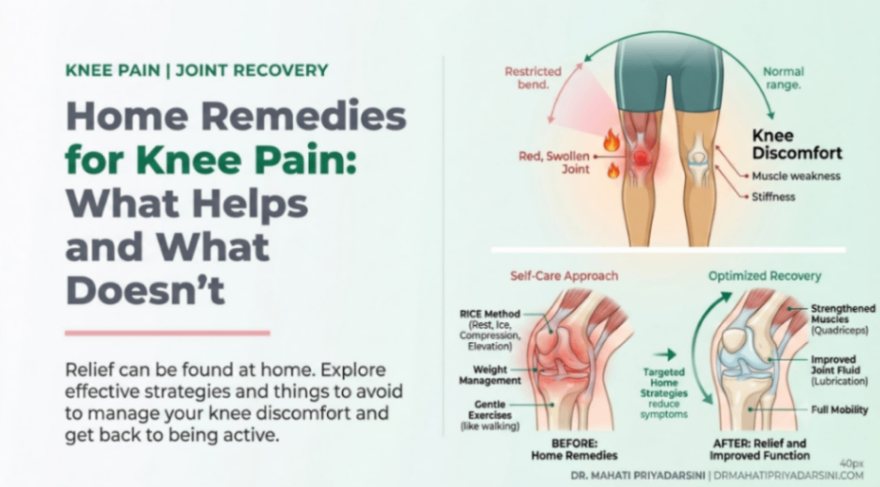
Knee pain can make many simple parts of your day uncomfortable. Getting out of bed standing after sitting for a time walking to work or climbing a flight of stairs can suddenly remind you that something is not quite right.
When knee pain starts most people do not go to a doctor right away. They use what they already have at home. An ice pack, a compress a pain relief spray, some rest or maybe a few exercises they found online.
Some of these things can help knee pain. Others may only give relief and a few can actually be unhelpful depending on what is causing knee pain.
The important thing is to understand what your knee needs than trying every home remedy you come across. Mild knee pain often settles with the care but knee pain that keeps returning needs a closer look.
Here's what can help and what may not.
Why does knee pain happen?
Your knees deal with a lot of stress every day. Your knees carry your body when you stand up or walk around. Your knees also absorb force when you move and bend your legs over and over. You might feel pain because you used your knees much or maybe because of weak muscles, an old injury or arthritis. Problems with your cartilage, tendons or ligaments can also cause knee pain. Sometimes the reason for the knee pain is easy to see, like when you feel sore after a workout. Times the knee pain just shows up slowly without a clear reason. This is why you will not find one home remedy that works for every type of knee pain.
Home remedies that can help :
1.Ice for swelling and soreness:
If your knee gets swollen or hurts after you exercise or do some activity a cold pack can help make it feel better and reduce the swelling. Put the ice pack in a piece of cloth and put it on your knee for about 15 minutes. You can do this again during the day if you need to. Ice can make your knee feel better. Keep in mind that it only helps with the pain and swelling. It does not fix the reason why the knee is hurting. If the swelling comes over and over don't just keep using ice. Try to find out what is causing it.
2. Heat for stiffness:
Heat can be useful when stiffness is the problem. I have noticed that heat can be useful when stiffness is the problem. A warm shower or warm compress can help relax muscles and make the knee easier to move especially after you have been sitting in one position for a long time.. Heat is not always the right choice. If the knee is already swollen or feels hot after an injury cold therapy may be more appropriate.
3. Gentle movement:
When the knee hurts your first instinct may be to stop moving. I understand how that feels. However much rest can leave the knee joint stiff and the surrounding muscles weaker. Walking, stretching and comfortable range‑of‑motion exercises can help you stay mobile without putting excessive stress on the knee. The aim is not to exercise through pain. The aim is to keep the knee moving without making the symptoms worse.
4. Strengthen the muscles around the knee
Your thigh and hip muscles help support the knee during movements. If the thigh and hip muscles are weak more stress can end up going through the knee joint. Simple strengthening exercises can improve support. Make daily activities easier. However the right exercise depends on the reason, behind the knee pain. If you are unsure which exercises are safe a physiotherapist can guide you of leaving you to guess.
5. Reduce activities that trigger pain:
You do not necessarily have to stop being active when the knee hurts. Instead look at which activities are making the knee worse. If running, jumping, deep squats or repeated stair climbing consistently trigger pain reduce them temporarily. Choose gentler forms of movement. Giving a knee some time to settle does not mean becoming completely inactive.
What does not always help?
Not every popular home remedy is a solution for knee pain.
Pain‑relief creams and sprays may provide comfort but they do not necessarily treat the reason the knee is hurting. If you need them repeatedly just to get through activities it is worth finding out what is causing the problem.
The same applies to home mixtures, oils or other natural remedies that are commonly recommended online. They may feel soothing. There is no simple kitchen remedy that can repair damaged cartilage or reverse a significant joint problem.
Another common mistake is doing much too soon.
You may feel slightly better after resting or using ice. Then immediately return to your usual workout. If the knee is not ready the pain can simply come back.
Should you rest completely?
Not usually.
Resting can be useful when the knee is irritated after strenuous activity or a minor injury.. Staying completely inactive for days or weeks can lead to stiffness and muscle weakness.
.A better approach is often to reduce the activity that is causing pain while continuing movement that feels comfortable. The knee needs a chance to recover. It also needs to keep working.
When should you stop treating knee pain at home?
Some knee pain improves within a days with simple care.. Do not keep trying different remedies if the problem is not improving. See a specialist if you have:
• Pain that continues for than two to three weeks
• Swelling, warmth or redness around the knee
• Difficulty putting weight on the leg
• A knee that locks. Gives way
• Pain that keeps returning after activity
• Pain that is becoming worse or disturbing your sleep
These symptoms may mean there is a problem that needs proper assessment.
When to get help?
Home remedies can be useful for short‑term knee pain but they are not a replacement for diagnosis when the symptoms persist.
A specialist can determine whether the knee pain is related to arthritis, muscle weakness, an injury, cartilage problems or another condition. Once the cause is clear treatment can be focused on the problem rather than simply reducing the pain for a few hours.
Depending on the cause treatment may include physiotherapy, targeted exercises, medication, injections or other approaches.
The bottom line:
Not every episode of knee pain needs complicated treatment. If the discomfort is mild, reducing the activities that make it worse, using ice or heat when appropriate, and keeping the knee gently moving may help you feel more comfortable.
However, feeling better for a few hours or days doesn't always mean the underlying problem has gone away.
If the pain keeps coming back, swelling doesn't settle, or the knee starts affecting the way you walk, exercise, sleep, or manage everyday activities, don't keep relying on home remedies. Getting the problem assessed can help identify the cause and guide you toward the right treatment.