Knee Pain Doctor in Hyderabad: When Should You Consult a Specialist?
Your knee hurts when you climb stairs. Maybe your knee aches after you have been sitting for a while. You notice knee pain every time you get up from a chair.
At first it is easy to brush it off. You might think it is just because you walked much or exercised harder than usual. You might think it is just because you are getting older. Sometimes that is all it is.
If the knee pain keeps coming back or gets worse or starts making everyday things difficult your knee may be telling you that something needs attention.
Here is how to know when it is time to see a knee pain doctor in Hyderabad.
Why does knee pain happen?
Your knees do a lot of work every day. Walking, climbing stairs, squatting, running, getting up from a chair. Your knees are involved in everything you do. So it is not surprising that they can sometimes start complaining.
Some of the common reasons for knee pain are:
· Knee osteoarthritis : is one of the common causes especially after the age of 40. The smooth cartilage that cushions the knee gradually wears down. As it becomes thinner the joint can become painful, stiff and sometimes make a grinding or clicking feeling.
· Patellofemoral pain : is pain around or behind the kneecap. It is often worse when climbing stairs, squatting, running or getting up after sitting for a time.
· Meniscus problems: happen when the meniscus is torn or worn. You may notice pain, catching, locking or a feeling that the knee might give way.
· Tendon problems : happen when the tendons around the knee become irritated from overuse. This usually causes pain around the kneecap particularly when climbing stairs jumping or exercising.
· Weak or tight muscles : can also cause knee pain. Sometimes the knee itself is not the problem. Thigh and hip muscles can make the knee work harder than it should. Tight muscles can also affect the way the joint moves.
Sometimes more than one of these problems can be present at the same time.
That is why simply taking a painkiller and hoping it goes away is not always the answer.
When should you see a knee specialist?
Not every episode of knee pain needs a doctor.
If your knee aches after an active day and settles down with some rest there is usually no reason to panic. There are certain signs you should not keep ignoring.
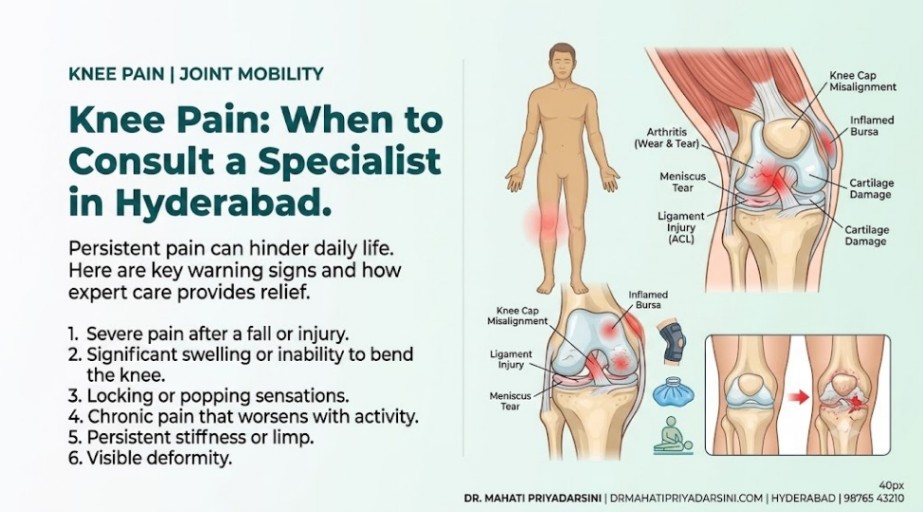
It is worth seeing a specialist if :
· Your knee pain has lasted than two to three weeks
· The pain keeps coming back
· Your knee is swollen, warm or red
· Your knee locks or catches when you move it
· It feels like your knee might give way
· You are struggling to put weight on the leg
· You are walking with a noticeable limp
· The pain is gradually getting worse
· Knee pain is disturbing your sleep.
These do not automatically mean there is something going on. They simply mean it is time to stop guessing and find out what is actually causing the knee pain.
What about knee pain while climbing stairs?
This is a common warning sign. You may be perfectly comfortable walking on ground but suddenly notice a sharp or aching pain when you go upstairs. Why? Stairs put more demand on your knees than ordinary walking. When you climb your knee bends deeply while your leg pushes your body weight upwards. Going downstairs can be even harder because the knee has to control your body as you come down.
So a knee problem that barely bothers you while walking can become very obvious on stairs. Common causes include arthritis, kneecap-related pain, cartilage problems tendon irritation and muscle weakness. If stairs have suddenly become something you dread do not just assume it is normal.
How do you know if it is more than an ache?
A mild knee ache that appears after activity and settles with rest is usually less concerning. Knee pain that keeps returning is different. Knee pain that comes with swelling, locking, instability, difficulty walking or increasing stiffness deserves proper attention.
Your knee does not have to be completely unbearable before you see a specialist. In fact that is one of the mistakes people make. They wait until the knee pain becomes bad enough to interfere with life. By then a problem that might have been easier to manage can become more difficult.
What happens when you see a knee pain doctor?
The first thing a specialist needs to understand is why your knee hurts. That means looking at your symptoms how the knee pain started what movements make it worse and how well your knee is moving.
Depending on what they find you may need evaluation to understand whether the problem is coming from the joint, cartilage, tendons, muscles or something else. Once the cause is clear treatment can be planned around the problem.
This may include
· Physiotherapy and strengthening exercises
· Temporary changes to activities that aggravate the knee pain,
· Pain-relieving medicines when appropriate
· Targeted injections in selected cases
· Other treatments depending on the underlying condition.
The important thing is that treatment is not the same for everyone. A person with thigh muscles does not need the same treatment as someone with osteoarthritis. Someone with a meniscus problem may need a different approach.
That is why getting the diagnosis matters.
What can you do at home for knee pain?
If your knee pain is mild and has recently started a few simple things may help.
· Give your knee a break: Avoid doing activities that make the knee pain worse.. Do not stop moving completely. Gentle movement is still important.
· Use ice if there is swelling: A cold pack for around 15 minutes after activity can help settle knee pain and swelling. Strengthen the muscles around your knee.
· Strong thigh and hip muscles: can take some of the pressure off the knee. The right exercises can make a difference but it is best to learn them properly rather than randomly trying exercises from the internet.
· Use the handrail on stairs: If stairs hurt, holding the rail and taking some of your weight through your arms can reduce the load on the knee.
· Keep an eye on your weight: Even a small amount of weight increases the work your knees have to do, particularly on stairs.
These things can help with symptoms.. If the knee pain is not settling, do not keep repeating the same home remedies indefinitely.
When home care is not enough:
The truth is, home care can only do much if there is an underlying problem. If your knee continues to hurt despite rest or if the knee pain keeps returning every weeks it is worth finding out why.
A specialist can work out whether you are dealing with arthritis, a cartilage problem, tendon irritation, muscle weakness or another cause. The goal is not simply to make the knee pain disappear for a hours. It is to understand what is causing it and build a treatment plan that helps you stay active.
A realistic word about knee pain:
Knee pain can be frustrating especially when it starts interfering with simple things you never used to think about. Climbing stairs going for a walk getting up from a chair or playing with your children.
Knee pain does not automatically mean your knee is finished or that surgery is the only option. Many knee problems can be managed with the combination of diagnosis, exercise, physiotherapy, lifestyle changes and appropriate treatment.
The important part is not waiting until the problem becomes unbearable.
The bottom line:
An occasional knee ache is not always something to worry about.
But if your knee pain lasts for than two to three weeks keeps coming back gets worse causes swelling or instability or starts affecting your everyday activities it is time to get it checked.
If you are looking for a knee pain doctor in Hyderabad getting the problem properly assessed is the step, towards understanding what is really going on. And finding the right way forward.
Your knees carry you everywhere. They are worth looking after.