Migraine During Periods: Why Hormonal Changes Can Trigger Severe Headaches
It starts with a feeling you know
Your period is about to begin and along with the cramps and tiredness a headache slowly starts to come. At first you think you can handle it. Then the light around you feels too bright your phone screen becomes annoying. Even normal sounds seem louder than they should.
By the time the pain's fully here getting through the day feels like a big job.
If this happens around your period again and again there may be a reason for that pattern.
For some women the days around menstruation are also the days when migraine's most likely to happen. Hormonal changes, the drop in estrogen, before a period can be a big part of it. Hormones aren't always the only cause.
Here's what may be happening.
What is a menstrual migraine?
A menstrual migraine is a migraine that happens around the time of menstruation.
It often shows up a days before a period starts and in the first few days after bleeding begins.
Some women get migraines during their period. Others have attacks at times of the month too.
The timing is the key.
If you see that your worst headaches keep showing up before your period or, in the first few days of it noting that pattern can help a lot.
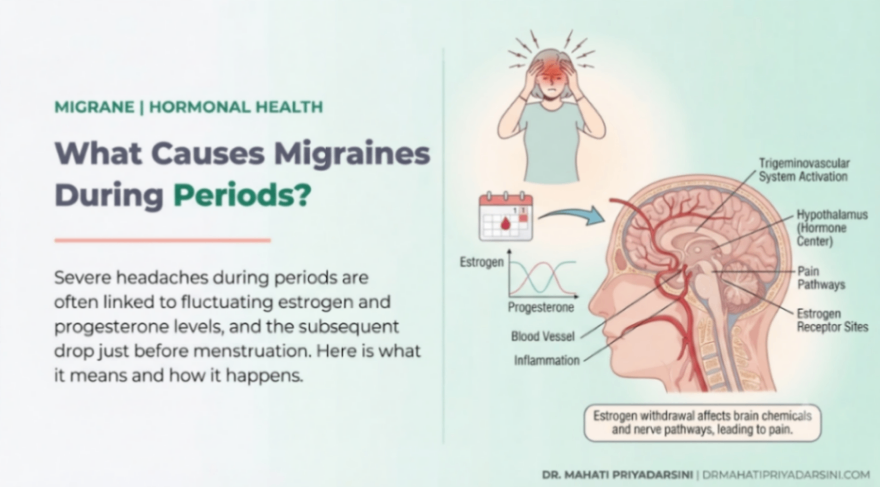
Why does a period trigger migraine?
The menstrual cycle has changes in hormone levels.
One of the changes occurs right before a period, when estrogen levels drop. For women who're sensitive to these shifts, in hormones this quick change can increase the chance of a migraine.
So it's not always because your estrogen is just "too low."
The change itself might be the factor.
Since this hormone shift is a normal part of the menstrual cycle the same pattern can happen again and again each month.
Why can menstrual migraine feel so severe?
This is where many women notice that their period-related migraine isn't quite like an ordinary headache.
The pain can be stronger and may last longer. Nausea, vomiting and sensitivity to light or sound can make the whole experience even more difficult.
A migraine that arrives during your period can also interfere with things you would normally do without thinking working, attending college, looking at a screen, driving, cooking or spending time with your family.
That is why calling it "just a period headache" can sometimes make the problem sound much smaller than it actually is.
Hormones may not be the whole story
Your period may be the main trigger, but look at everything else happening during those few days.
You may be sleeping badly because of cramps.
You may eat at different times.
You might drink less water than usual.
Work or family stress may be higher.
Your normal routine can change without you even noticing.
Any of these factors may contribute to migraine. When several of them happen at the same time as a hormonal change, an attack may become easier to trigger.
Sometimes, therefore, it isn't one thing that causes the migraine. It's the combination.
How do you know if your migraine is linked to your period?
The easiest way is to stop guessing and start tracking.
For the next few menstrual cycles, make a simple note of:
· When your period starts
· When the headache begins
· How severe the pain feels
· How long the attack lasts
· Whether you have nausea or vomiting
· Whether light or sound becomes difficult to tolerate
· What medication you took and whether it helped
· How you slept, ate and hydrated around that time
What can you do before the migraine arrives?
Once you know your pattern, you can prepare for it instead of being caught completely off guard.
Try to keep your routine as steady as possible around your period.
· Get enough sleep and avoid major changes to your sleep schedule
· Don't regularly skip meals
· Drink enough water throughout the day
· Keep your caffeine intake consistent
· Make time for breaks if stress is high
· Continue tracking your periods and migraine attacks
What treatment is available?
There isn't one treatment that works for every woman.
The right approach depends on how often your migraines occur, how severe they are, how long they last and your overall medical history.
Some people may need medication to treat the migraine once it begins. If attacks happen predictably around menstruation, a doctor may also consider a short preventive treatment around that period. Women who experience frequent migraines throughout the month may need a different long-term prevention plan.
Hormonal treatment can sometimes be considered as well, but it isn't appropriate for everyone.
This is particularly important for women who experience migraine with aura, because certain estrogen-containing contraceptives may not be suitable. Hormonal medication or contraception should therefore be discussed with a doctor rather than started specifically for migraine without medical advice.
When should you see a doctor?
You don't have to simply accept severe migraine as something that comes with your period.
Speak with a doctor if:
· Your migraine becomes severe around most periods
· Your attacks are lasting longer than usual
· Your usual treatment is no longer helping enough
· Migraine is causing you to miss work, college or normal activities
· Your headaches are becoming more frequent
· Your usual migraine pattern suddenly changes
· You develop new or unusual neurological symptoms
A realistic word about menstrual migraine
There is one thing worth remembering.
If your migraine happens because of hormonal changes, it isn't a failure on your part.
You can sleep well. You can eat properly. You can drink enough water. You can do everything you normally do and still develop a migraine when your hormones shift.
That doesn't mean you're powerless.
It means the goal is to understand your pattern instead of simply waiting for the pain to arrive every month.
Start with the dates. Notice when the migraine begins. Write down what it feels like and how long it lasts.
After a few cycles, "I always get a terrible headache around my period" becomes something much more useful: a clear pattern that you and your doctor can actually work with.
And with the right diagnosis and treatment plan, those difficult few days don't necessarily have to control your month.