Most People Ignore These Back Pain Symptoms Until It's Too Late
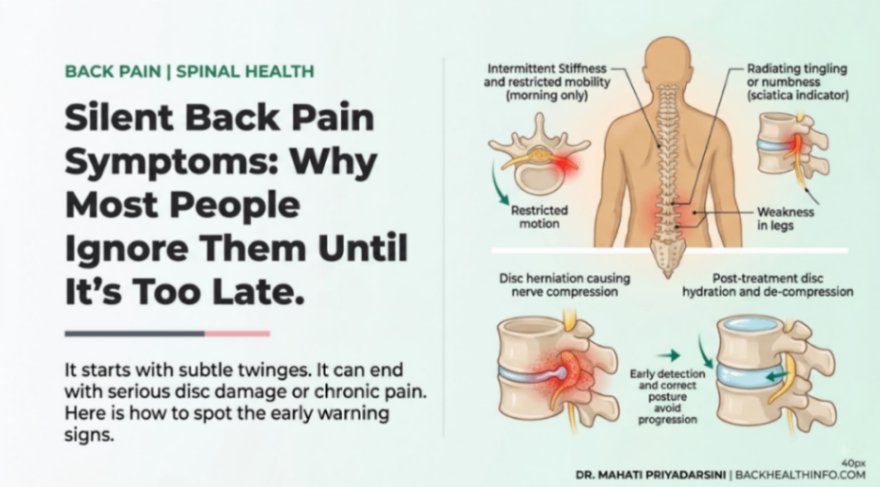
You know when you wake up with a sore back and think, “I probably just slept in a weird position”? Or you spend the day sitting at work and notice a dull ache in your lower back, so you ignore it because you assume it will go away on its own?
You are definitely not the only one who does this.
Back pain is something people are really good at putting off. We take a day to rest, use a heat pack, take some medicine for the pain, and then go back to our normal routine. Sometimes, that is all we need to do. But when the pain keeps coming back, starts spreading to other parts of the body, or begins to affect the way you move or sleep, it is time to pay attention.
The tricky part is that back pain can be caused by many different things. It could be something simple, such as a muscle strain or poor posture. But some symptoms can also be linked to problems involving the nerves, discs, or spine.
That is why it is important to know which back pain symptoms you should not simply brush off.
Here are some back pain symptoms that deserve your attention.
Why is back pain so common?
Your back plays an important role in almost everything you do. Sitting, standing, bending, lifting, walking, and even turning in bed all involve your back. If you sit at a desk for long periods, have poor posture, lift something suddenly, do not move around enough, or strain your muscles, back pain can develop.
At first, a small problem with your back might not seem like a big deal. You may feel a little stiff in the morning, or your back may hurt after sitting for a few hours. Because you can still get through your day, it is easy to put the pain out of your mind. Your back is still doing its job, even if it is hurting a little.
Back pain symptoms you shouldn't ignore
1. Pain that keeps coming back
Back pain that shows up after a long day and improves with rest is not always something to worry about. But if the same pain keeps coming back every few days or weeks, do not assume that it is something you simply have to live with.
Recurring pain can mean that the original problem has not properly settled, or that something in your daily routine is continuing to put stress on your back.
2. Pain that is getting worse
Pain that is getting worse is another reason to pay attention. Simple strains often improve gradually with time and appropriate care.
If your back pain is becoming stronger instead of easing, or activities that were once easy are now becoming difficult, it is worth getting it checked. Pain that steadily gets worse should be assessed rather than repeatedly managed with rest and pain medicine alone.
3. Pain travelling into your leg
Sometimes, the problem is not limited to your back. If pain moves from your lower back into your buttock, thigh, calf, or foot, it may be related to an irritated or compressed nerve.
You may describe this pain as sharp, shooting, burning, or like an electric shock rather than the usual dull ache. If this keeps happening, do not simply wait for it to disappear on its own.
4. Numbness or tingling
A stiff back after sitting for a long time is common. Numbness and tingling are different.
Pins and needles, burning, or reduced sensation in your back, buttocks, legs, or feet can happen when a nerve is irritated.
It is especially important to pay attention when these sensations occur along with pain travelling down the leg or changes in muscle strength.
5. Weakness in your leg
Have you noticed that one leg feels weaker than it normally does? Maybe climbing stairs has become harder, your foot feels unusually heavy, or you are having trouble with movements that used to be easy.
Do not simply assume it is because you are tired if it keeps happening. Changes in strength can sometimes be connected to nerve problems, and a proper assessment can help identify the cause.
6. Back pain that wakes you at night
Back pain after a long day can happen. But pain that repeatedly wakes you during the night should not be ignored, especially if it is persistent or getting worse.
Your sleeping position can affect back pain, but if the pain continues to disturb your sleep, it deserves a closer look rather than simply changing your pillow or mattress and hoping it goes away.
7. Difficulty controlling your bladder or bowel
This is a symptom that needs urgent attention. If you have back pain along with a sudden loss of bladder or bowel control, difficulty passing urine, or numbness around the groin, inner thighs, or buttocks, seek medical help right away.
Warning signs you shouldn't ignore
Some back pain settles with simple care. But it is important to see a healthcare professional if you notice:
• Pain that continues for several weeks without improving
• Pain that keeps returning despite rest and home care
• Pain that moves into your buttock or leg
• Numbness, tingling, or burning sensations
• Weakness in one or both legs
• Difficulty walking or carrying out normal activities
• Pain that is steadily getting worse
• Pain that regularly disturbs your sleep
• Problems with bladder or bowel control
• Numbness around the groin or inner thigh area
These signs do not necessarily mean that something serious is wrong. They do mean that trying to figure out the cause by yourself is not a good idea. A proper assessment can help determine what may be causing the pain and what kind of treatment, if any, is needed.
What you can do at home
For recent, uncomplicated back pain, a few simple steps may help:
• Keep moving. Avoid staying in bed for long periods. Gentle movement is usually better than complete inactivity.
• Take breaks. If you sit for hours at work, get up, walk around, and change your position regularly.
• Use heat or cold. A warm pack may help relax tight muscles, while a cold pack can sometimes help with pain after a recent strain.
• Pay attention to your sitting position. Your chair, desk height, and screen position can all affect how much strain your back takes.
• Avoid heavy lifting while your back is painful. Repeated bending or lifting can make an irritated back feel worse.
• Try gentle stretching. Once the worst of the pain has settled, appropriate stretching and movement may help reduce stiffness.
When to get professional help
Home care can be useful for mild, short-term back pain, but it is not a substitute for a proper assessment when the pain does not settle.
A healthcare professional can assess your symptoms and movement to help understand where the pain may be coming from. It could involve the muscles, joints, discs, nerves, or other structures in the back.
Treatment will depend on the cause of the pain. It may include guided physiotherapy, specific exercises, medication, targeted injections, or other pain-management approaches.
The goal is not simply to make the pain disappear. It is also to understand what is causing the pain and address the underlying problem as appropriately as possible.
The bottom line
Back pain is common, but that does not mean every type of back pain should be ignored.
A little stiffness after a long day may settle with rest and gentle movement. But pain that keeps returning, gets worse, travels down your leg, causes numbness or weakness, or starts affecting your sleep deserves attention.
You do not have to panic every time your back hurts. But you also should not keep pushing through it when your body is repeatedly telling you something is wrong.
If your back pain is getting worse or is affecting your daily life, getting it checked can help you understand what is going on and what you should do next.
Your back can give you warning signs for a reason. Listen to them and take care of your back.