Not Just Tired Feet: What Your Foot and Ankle Pain May Be Telling You
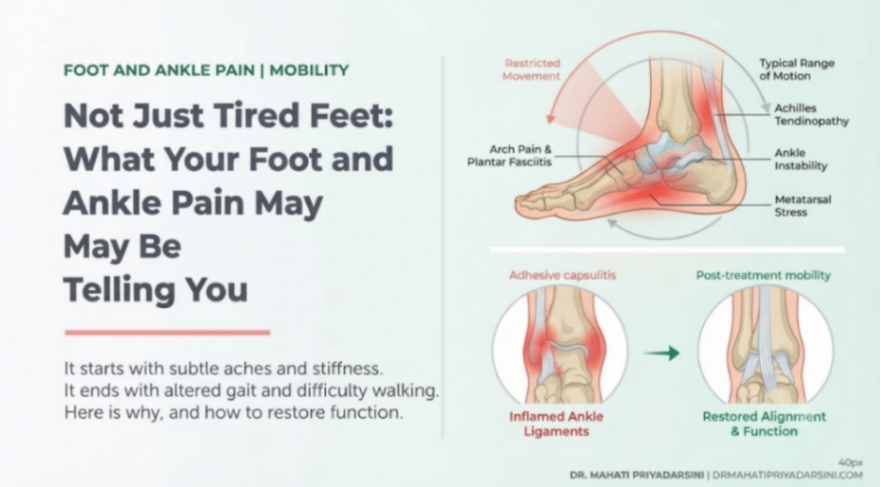
You finish work leave the office and finally sit down.
That is when you notice it.
Maybe there is a pain under your heel. Your ankle feels stiff when you stand up. Maybe your feet feel heavy or uncomfortable after what seemed like a day.
It’s easy to think "My feet are just tired."
Sometimes they are.
When the same pain comes back again and again the place where it hurts the time it shows up and the way it feels can point to something more.
This matters, for people who spend most of the day sitting at a desk.
Even if you spend most of your day at a desk your feet still carry you through the commute stairs, walking between meetings trips, to the store and everything else you do after hours.
Instead of just asking, "Why are my feet tired?" maybe it’s better to ask.
Start with where the pain actually is:
Foot and ankle pain is not one single issue.
Pain under the heel can come from a reason than pain at the back of the heel. Pain near the ankle can be caused by something, than burning or tingling in the toes.
That is why just saying "my foot hurts" does not share the picture. It is important to ask:
Try to notice:
Where exactly does the pain begin?
Does it appear after sitting, walking or standing?
Is it worse in the morning or towards the evening?
Does it improve once you start moving?
Is there swelling?
Does the sensation feel like an ache, burning, tingling or a sharp pain?
These small details can make an assessment much more useful.
Heel pain with your first few steps
Many people feel pain under the heel when they first get out of bed.
You might take a steps and the bottom of your heel feels unusually painful or tight.
Sometimes a similar feeling shows up when you stand after sitting for a time like during a meeting or a long journey.
One possible reason is plantar fasciitis, where the tissue, along the bottom of the foot becomes irritated.
It may be linked to changes, in activity, prolonged standing, more walking or shoes that do not suit your feet.
The important point is that recurring morning heel pain should not be dismissed automatically as tiredness.
Pain at the back of the heel
Now I think about where the pain's located.
If the discomfort is at the back of the heel, near the Achilles tendon the pattern changes. I might feel stiffness when I start walking after sitting. Walking uphill climbing stairs or exercising can make the discomfort more clear. This can happen when the tendon is repeatedly pushed to carry weight than it is used to handling.
For example a person who is mostly inactive, on weekdays may suddenly start workouts on weekends.
The problem may not show up in the few minutes. Instead soreness and stiffness can grow more noticeable later.
That is why increasing activity slowly is important.
When ankle pain keeps appearing by evening
An ankle that becomes uncomfortable towards the end of the day can have several possible causes.
Sometimes it is related to repeated loading. In other cases, a tendon, ligament or joint may be involved.
Pay attention to what accompanies the pain.
Is there swelling?
Does the ankle feel stiff?
Does it feel unstable?
Does the pain happen every evening or only after active days?
An occasional ache after a day is different from ankle pain that repeatedly returns.
If the same symptoms keep happening finding the cause is more useful, than treating the discomfort as fatigue again.
What if your feet feel heavy rather than painful?
Not everyone describes foot problems as pain.
Some people notice that their feet feel:
Heavy
Tight
Full
Uncomfortable inside their shoes
Swollen towards the end of the day
Temporary swelling can happen after standing for times or being active.. Persistent swelling needs more care especially if swelling keeps coming back or if swelling is much worse, on one side. Swelling that comes with pain, redness or heat should be checked by a doctor of just blaming swelling on a long workday.
Burning, tingling or numbness is a different kind of symptom
A burning sensation in your feet is not quite the same as ordinary soreness.
Neither is tingling.
You may describe it as:
Pins and needles
Burning in the sole
Numbness in the toes
An electric or shooting sensation
A feeling that the foot has “fallen asleep”
These symptoms sometimes show up when a nerve gets irritated or squashed. There are many other reasons that could make them appear.
If these symptoms keep happening simply changing your shoes might not fix the problem.
You need to find out where the symptoms are coming from.
When the pain changes the way you walk
This is something many people overlook.
Perhaps you have started putting more weight on the other foot.
Maybe you avoid stairs because your ankle hurts. Or you take shorter steps because putting your heel down is uncomfortable.
Your body often changes how you move on its own when something hurts.
Sometimes a little discomfort goes away by itself. If you are always changing how you walk to stop the pain its a good idea to have it checked out.
Keeping on fixing one area can also put more pressure on other parts of the leg.
Your shoes can provide useful information
Your footwear is worth looking at, but it should not automatically be blamed for every foot problem.
Try noticing whether your symptoms change between different pairs of shoes.
For example, do your feet become uncomfortable after several hours in one pair but feel better in another?
Do your toes feel squeezed?
Does the heel rub against the back of the shoe?
Does the shoe feel too hard or unstable while walking?
A comfortable shoe should give your toes enough room and feel stable while you move.
However, if changing footwear makes little difference and the pain continues, the problem may require more than a footwear change.
What happens after you leave the office matters too
Your workday may end at 6 p.m., but your feet may still have several hours of work ahead.
There may be a commute, grocery shopping, household activities, stairs or an evening workout.
If your feet are already uncomfortable, suddenly adding a long walk or intense exercise may increase the load on the painful area.
That does not mean you should stop moving altogether.
The right level of activity depends on what is causing the pain.
For mild, temporary soreness, simple measures such as comfortable footwear, short periods of rest and gentle movement may help.
But repeated pain needs a different approach.
When should foot and ankle pain be checked?
Not every foot ache requires a medical consultation.
But certain patterns are worth paying attention to.
Consider getting your foot or ankle assessed if:
The same pain keeps returning
Symptoms continue for several weeks
Pain is becoming stronger
You are changing the way you walk
You have repeated swelling
You have persistent morning heel pain
You experience numbness, burning or tingling
Your ankle feels weak or unstable
Walking or climbing stairs has become difficult
The pain started after an injury
A sudden severe injury, obvious deformity or inability to put weight on the foot requires prompt medical attention.
What happens during an assessment?
When you see a doctor for persistent foot or ankle pain, the painful spot is only one part of the assessment.
The doctor may want to understand:
When the pain started
Exactly where you feel it
What makes it better or worse
Whether it is worse in the morning or evening
Whether there has been an injury
Whether you have swelling or stiffness
Whether you experience numbness or tingling
How your symptoms affect walking and daily activities
The foot and ankle can then be examined for tenderness, movement, strength and other signs that may help identify the problem.
The treatment depends on the cause.
Sometimes activity modification, exercises or footwear changes may be sufficient. Depending on the condition treatment may also involve physiotherapy, medicines, supportive devices or other appropriate interventions.
The goal is not simply to make the pain disappear temporarily.
The goal is to understand why it is happening in the place.
Don't let the end of your workday become the start of your pain
Your feet do a lot more than carry you from your desk to the parking area.
They support you while you walk climb stairs, commute, exercise and manage life.
So if your feet occasionally feel tired after a day that may not be unusual.
If the same heel pain, ankle stiffness, swelling, burning or tingling keeps appearing it deserves more attention.
Start by noticing the pattern.
Where does it hurt? When does it hurt? What does it feel like?. Is it changing the way you move?
Those details can help point towards the evaluation instead of simply labelling everything as "tired feet."
If you are looking for pain management in Hyderabad an appropriate assessment can help identify whether the discomfort is related to the heel, tendon, ankle, nerves, an old injury or another underlying cause.
Your feet may be telling you something.
It is worth listening before the discomfort starts interfering with the things you actually want to do.