What Causes Pain While Climbing Stairs?
What Causes Pain While Climbing Stairs?
For most of us, climbing stairs is something we do without a second thought. But if every step up or down sends a sharp twinge through your knee, hip, or leg, those everyday stairs can start to feel like a mountain. Stair pain is one of the most common complaints people bring to a doctor — and it's often an early warning sign that something in the joint needs attention.
The good news is that stair-related pain usually has a clear cause, and most of those causes are treatable. The key is not to ignore it. Pain that you brush off today can quietly get worse over months until simple movements become difficult.
If knee pain on the stairs has become part of your daily life, getting proper knee pain treatment in Hyderabad early can stop a small problem from becoming a big one. And for many people, relief starts simply — affordable pain relief medications available in Hyderabad, combined with rest and the right exercises, are often enough to settle the early stages.
Here's what could be behind your stair pain.
Why do stairs put extra stress on your joints
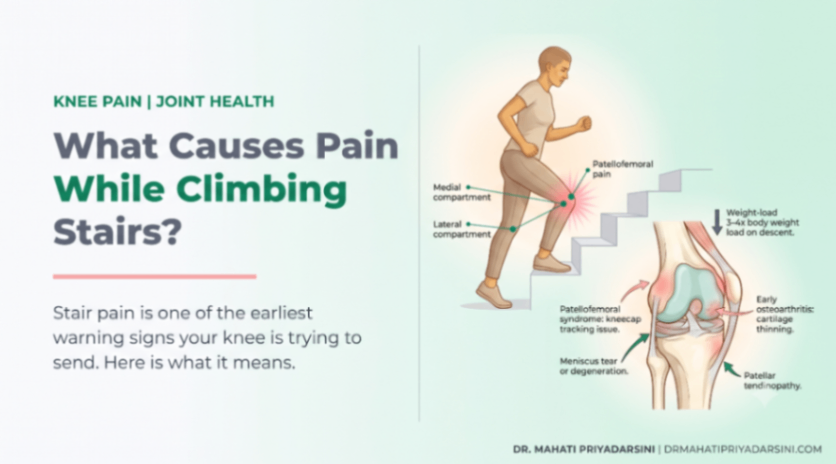
Climbing stairs is harder on your joints than walking on flat ground. When you step up, your knee bends deeply, and your leg has to push your entire body weight upward. Going down is even tougher — your knee absorbs a force several times your body weight with each step as it controls your descent.
This is why a joint problem that feels fine on flat ground can suddenly hurt on stairs. The stairs simply demand more from a joint that's already struggling.
Common causes of pain while climbing stairs
1. Knee osteoarthritis. This is the most common cause, especially in people over 40. The smooth cartilage that cushions the knee joint wears down over time, so the bones rub and grind. Stairs make it worse because they squeeze the joint under heavy load. Pain, stiffness and a grinding feeling are typical signs.
2. Runner's knee (patellofemoral pain). Here, the pain comes from the kneecap not gliding smoothly as you bend the knee. It's common in active people and often shows up as a dull ache around or behind the kneecap — worse on stairs, squatting, or after sitting for a long time.
3. Cartilage or meniscus problems. The meniscus is a piece of cushioning cartilage inside the knee. If it's torn or worn, deep knee bends on stairs can cause sharp pain, catching, or a feeling that the knee might give way.
4. Tendon problems. The tendons around the knee can become inflamed from overuse. This causes pain just below or above the kneecap that flares up with stair climbing and jumping.
5. Hip problems. Sometimes the pain isn't from the knee at all. Hip arthritis or tight hip muscles can cause pain in the hip, groin, or thigh that's most noticeable when you lift your leg onto a step.
6. Weak or tight muscles. Weak thigh and hip muscles force the joints to take more strain. Tight muscles pull the joint out of its natural line. Both can lead to pain even without any joint damage.
Warning signs to watch for
Some stair pain settles with rest. But see a specialist if you notice:
● Pain that lasts more than two to three weeks
● Swelling, warmth, or redness around the joint
● A knee that locks, catches, or feels like it might give way
● Difficulty bearing weight or a noticeable limp
● Pain that's getting steadily worse or disturbing your sleep
These can be signs of a problem that needs proper assessment rather than waiting and hoping.
What you can do at home
For mild, early stair pain, a few simple steps often help:
● Rest and reduce the load. Avoid repeatedly going up and down stairs while the joint is sore, but don't stop moving completely.
● Use ice for swelling. A cold pack for 15 minutes after activity can ease pain and swelling.
● Strengthen your muscles. Gentle exercises for the thigh and hip muscles take pressure off the joint. A physiotherapist can guide you safely.
● Watch your weight. Even a few extra kilos adds big stress to the knees on stairs.
● Use the handrail. Leaning on it slightly reduces the load on a painful knee.
When to get professional help
Home care works well in the early stages, but it isn't a substitute for a proper diagnosis when the pain persists. A specialist can find the exact cause — whether it's arthritis, a cartilage problem, or a muscle imbalance — and build a plan around it. This might include guided physiotherapy, targeted injections, or other treatments that address the real source of the pain instead of just masking it.
The bottom line
Pain while climbing stairs is your body's way of telling you a joint needs attention. It's common, it's usually treatable, and the earlier you act, the better your chances of staying mobile and pain-free.
Don't wait until the stairs become something you dread. If the pain keeps returning, get it checked — your knees carry you everywhere, and they're worth looking after.