Why Does Migraine Get Worse After a Long Day at Work?
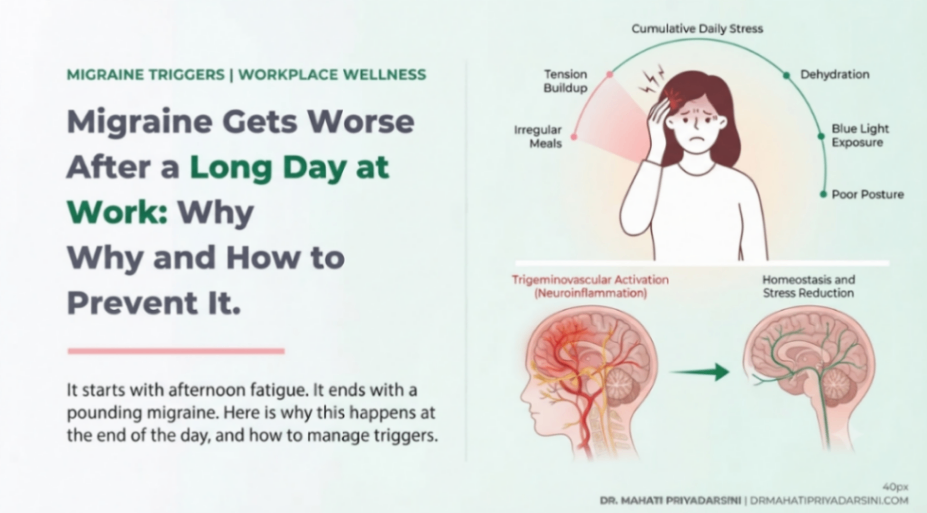
Ever noticed that a headache that felt easy to handle in the morning gets much worse by the time you leave work?
Maybe you have spent the day moving from one meeting to another looking at your computer skipping your lunch drinking not enough water and trying to finish one more task. Then just as the workday is over the headache really hits.
If that sounds like what happens to you you're not seeing things.
For people who have migraines a long and hard workday can bring together multiple things that cause headaches. The issue is not always the work. It is often what happens around the work. Spending much time in front of a screen missing meals feeling stressed not sleeping well not drinking enough water and the sudden change, in your usual routine.
What actually happens during a migraine?
Migraine isn't simply an ordinary headache.
It's a neurological condition that can cause throbbing or pulsing head pain, often along with sensitivity to light or sound, nausea, and sometimes visual disturbances.
The important thing is that migraine attacks can be triggered by a combination of factors. You may tolerate one trigger on its own without much trouble, but several appearing together over the course of a workday can push you closer to an attack.
And that's where a long day at work can become a problem.
1. Stress builds up throughout the day
A busy morning may not cause an immediate headache.
But after hours of deadlines, calls, meetings, difficult conversations and constant concentration, your body has been under pressure for much longer than you realise.
Stress is a commonly reported migraine trigger. For some people, the headache doesn't even appear while they're busy. It can show up later, when they finally slow down.
That's why you may sometimes notice the pain beginning on your way home rather than during the busiest part of the day.
2. You're staring at a screen for hours
Eight or ten hours of laptop and phone use can leave your eyes feeling exhausted.
Long periods of screen time may also mean fewer breaks, prolonged concentration and exposure to bright or flickering light. For someone already prone to migraine, that combination can make an attack more likely.
The answer isn't necessarily to stop using screens altogether.
Small changes can help: take regular breaks, adjust your screen brightness, avoid sitting directly under harsh lighting, and give your eyes a chance to rest during the day.
3. Lunch gets pushed back again
This is an easy one to overlook.
You tell yourself you'll eat after the meeting. Then another call starts. Then there's an urgent task. Suddenly it's 3 PM and you've had little more than coffee.
Going too long without food can trigger migraine in some people. Long gaps between meals can also make an already exhausting workday harder to handle.
A regular eating routine is often more useful than waiting until you're extremely hungry.
4. You haven't had enough water
When you're busy, drinking water is surprisingly easy to forget.
You may start the day with coffee, have another cup in the afternoon, and realise at the end of the day that you barely drank any water.
Dehydration can contribute to headaches and may act as a migraine trigger for some people.
Keeping water within reach at your desk sounds almost too simple, but it makes remembering much easier.
5. Your shoulders and neck have been tense all day
Working at a desk for hours can leave your neck, shoulders and upper back feeling tight.
Poor posture, staying in one position for too long, and unconsciously tightening your muscles while concentrating can all add to the physical strain of a long workday.
For people who are already susceptible to migraine, that extra strain may become one more piece of the puzzle.
Getting up regularly, changing position and gently moving your neck and shoulders during the day can help reduce that buildup of tension.
6. Your sleep routine may be catching up with you
A difficult workday doesn't begin when you open your laptop.
If you've been sleeping poorly for several nights, your threshold for dealing with migraine triggers may already be lower.
Late nights finishing work, early mornings, irregular sleep timings and trying to catch up on sleep at the weekend can all disturb your routine.
Sometimes the migraine at 7 PM is partly the result of what happened the night before.
7. The office environment itself can play a role
Think about everything around you during a typical workday.
Bright fluorescent lights. Strong perfumes. Noise from conversations. Air-conditioning. Screen glare. A stuffy room.
None of these necessarily causes migraine in everyone. But if you've noticed that your attacks repeatedly happen in a particular workplace or environment, it's worth paying attention to the pattern.
Keeping a simple migraine diary can help you identify what tends to happen before an attack.
Why does the pain sometimes appear after work?
This is one of the most confusing parts.
You manage to get through the entire day, finish your work, and then the headache starts.
One possible reason is that the triggers have accumulated gradually. You may have spent hours dealing with stress, skipped a meal, had little water and stayed in front of a screen. The migraine doesn't necessarily need to appear the moment the first trigger happens.
There's also a practical change at the end of the day: your body finally gets a chance to slow down.
So the timing can make it look as though relaxing caused the migraine, when the contributing factors may have been building for hours.
What can you do during a long workday?
You don't need to completely redesign your working life.
Start with a few basics:
● Don't regularly skip meals or leave very long gaps between them
● Keep water near your workstation
● Take short screen breaks instead of working continuously for hours
● Move your neck, shoulders and body regularly
● Pay attention to harsh lighting or strong smells that repeatedly trigger attacks
● Try to keep your sleep and wake times reasonably consistent
● Notice whether stress, particular foods, missed meals or workplace conditions repeatedly come before an attack
The goal is not to eliminate every possible trigger. That's often unrealistic.
It's to understand your own pattern well enough to reduce the combination of triggers that pushes you into an attack.
When should you see a doctor?
Not every headache after work is a migraine, and frequent headaches shouldn't simply become something you learn to live with.
It's worth speaking with a doctor if:
● Your headaches are becoming more frequent or more severe
● You regularly need pain medication to get through the workday
● Your headaches are interfering with sleep, work or normal activities
● Your usual headache pattern suddenly changes
● You experience new neurological symptoms or unusual visual changes
● The headaches keep returning despite making changes to your routine
A proper assessment can help determine whether you're dealing with migraine or another type of headache and whether you need a more structured treatment plan.
The bottom line
A long day at work doesn't necessarily cause migraine by itself.
More often, it's the combination of everything that happens during those hours — stress, screens, skipped meals, dehydration, muscle tension, poor sleep and environmental triggers.
If your headaches repeatedly arrive after work, don't just blame the laptop.
Start looking at the entire day.
Once you understand what tends to happen before your migraine, it becomes much easier to have a conversation with a doctor about preventing and managing it rather than simply trying to push through the pain.